Chapter v
v.Turf in the home
The fire was the kitchen. It sat on a flat hearth at floor level, and it was rarely let go out.
Ó Dónaill’s word for the fireplace is teallach, and an open hearth is teallach oscailte.16 A turf fire is tine mhóna.16 At night the embers were raked over with ashes so the fire would hold until morning. Ashes are luaith; turf ash is luaith mhóna.16 In the morning someone blew the gríosach back to life. Ó Dónaill glosses gríosach as hot ashes and embers, and the dictionary’s own example is potatoes roasted in them.16
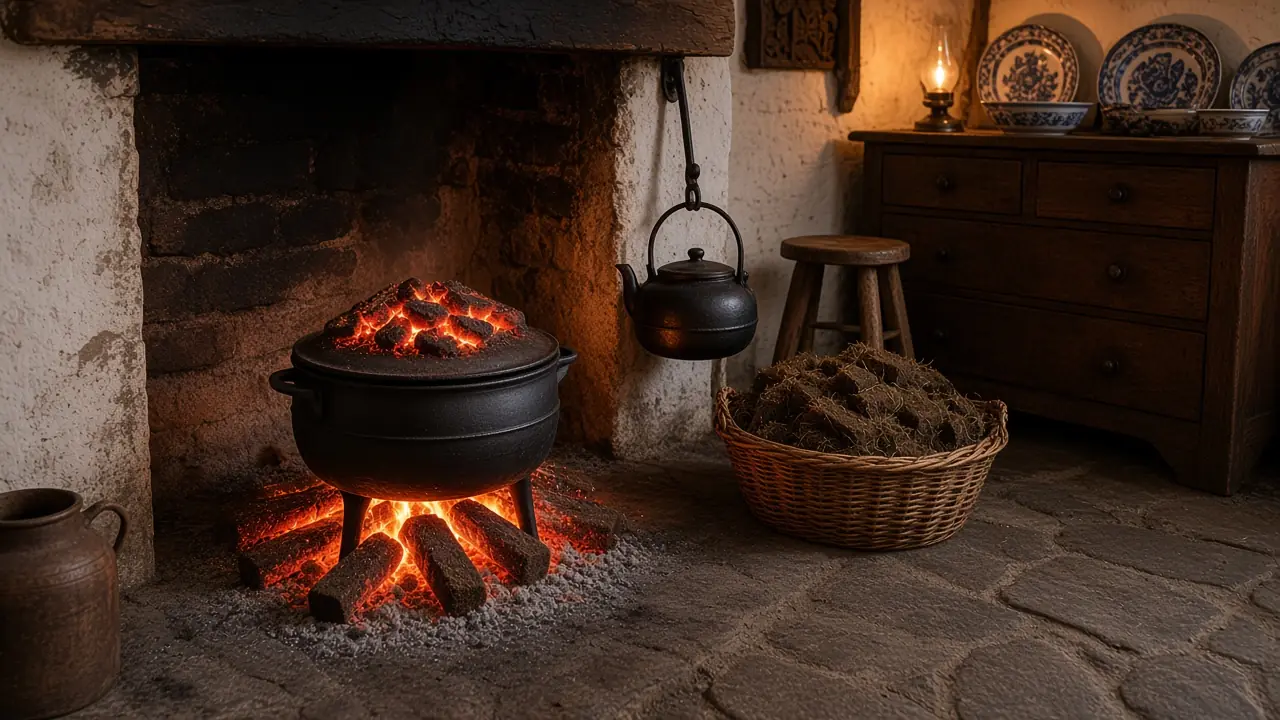
Bread was baked in a pot oven, also called a bastable: a cast-iron pot set down in the embers, with more hot turf heaped on the lid so the heat came from above as well as below. Ó Dónaill’s word for a pot is corcán.16 A crane, hinged at the hob, swung the kettle and the pots in over the heat and out again. The creel of sods, a cliabh, stood within reach.16
In the evening, certain houses were known as rambling houses. Neighbours came for stories, songs and cards in the firelight. That picture is the ordinary one in country memory; this page is not quoting a single dictionary entry for it, and it is not a study of the custom. What is on the record, in bulk, is the memory itself. In the 1930s schoolchildren wrote down local accounts of work, firesides and visiting for the Schools’ Collection of the National Folklore Collection, now searchable on Dúchas.17
The fuel they were describing is the same modest heat SEAI measures at about 13.1 MJ per kilogram of sod peat, once it is dry.10 Wet, it is still mostly water.2 A reek against the gable was the winter’s supply, built from the summer’s saving.